Applications

Faster scale-up and tech transfer with AI-enabled digital twins

Predict process performance at a new scale or site before you run it, with fewer engineering runs and consistent CQAs.

Book a Demo

Thank you! Your submission has been received!
Oops! Something went wrong while submitting the form.
Oops, this looks like a personal email. Please enter a business email address

Run your scale-up DoE virtually. Reduce physical trials by up to 50%.

Test scale-up strategies and operating conditions on a digital twin of the target equipment. Then run only the batches you need to confirm the prediction.

See a Virtual DoE
Scale-up

Right-first-time scale-up
with predictive physics-AI digital twins.

Simulate scale-up strategies, see predicted CQAs and equipment limits, and analyze the results with your team before the first batch is scheduled.
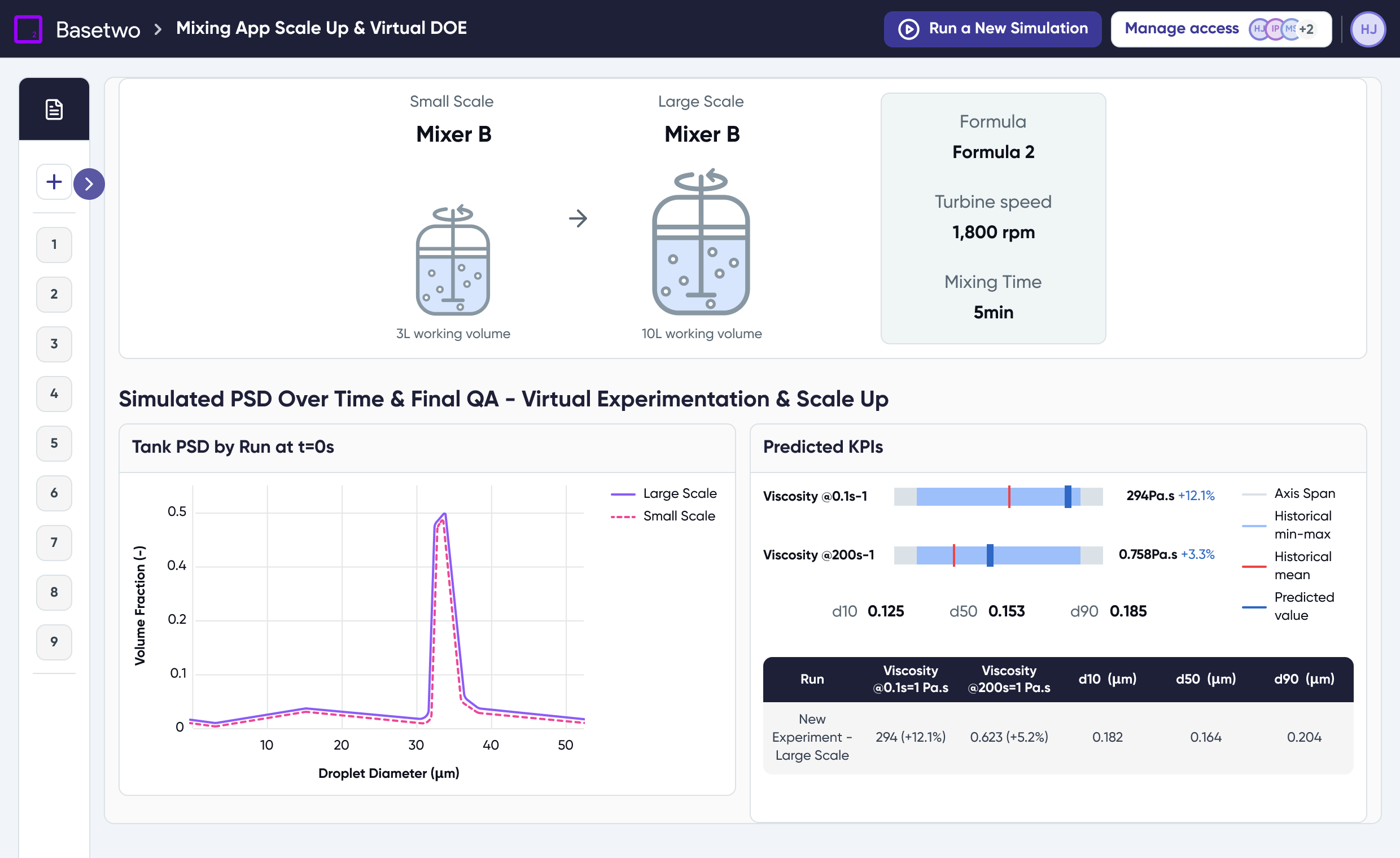
Basetwo Mixing App Scale Up and Virtual DOE: small and large scale mixers, simulated particle size distribution and predicted KPIs
With Basetwo
Test every scale-up option virtually
Predicted CQAs and equipment limits for each option.
Compare strategiesSide by side
Set operating conditionsPredicted in spec
Predicts at scale
CQAsProcess dynamicsEquipment limitsYield and impurities
Deviations & root cause analysis

Reduce site-to-site variability. Hit the same CQAs at every site.

Basetwo shows where sites differ and why, and recommends site-specific process design and control strategies for the receiving site or CDMO.
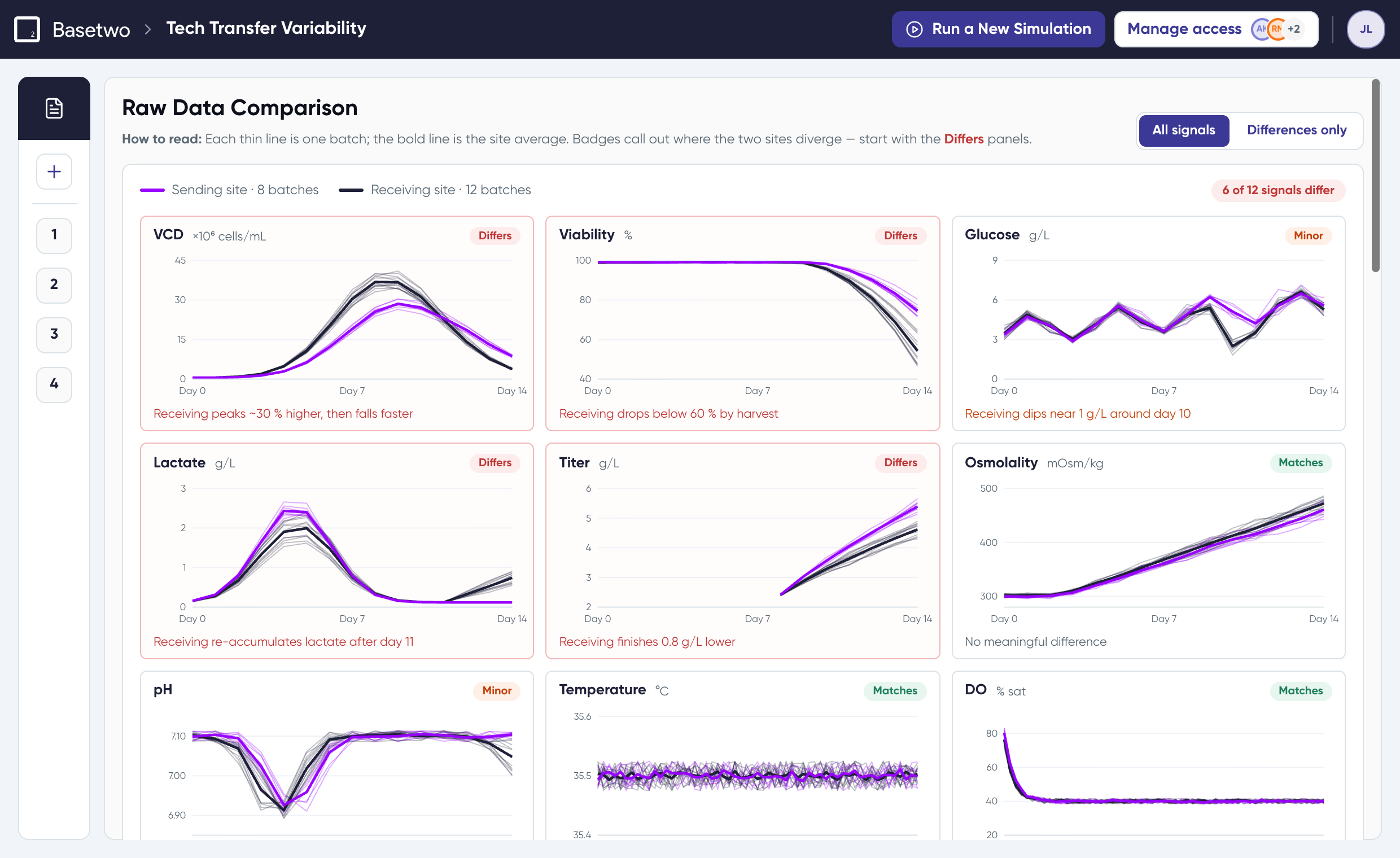
Basetwo Tech Transfer Variability: raw data comparison of sending and receiving site batches across VCD, viability, glucose, lactate, titer, osmolality, pH, temperature and DO
With Basetwo
Model-driven root cause analysis for sending and receiving site variability
Each site has its own model fitted to its specific data. Differences in model parameters inform the root cause analysis.
Compare sitesCQAs, CPPs & model parameters
Adjust per siteSetpoints & design changes
Accounts for
Site-to-site variabilityEquipment differencesRaw material variabilityOperating practices

How it works: A digital twin built on your data, equipment and process context.

01Connect your data

Bring in historian, MES and LIMS data with equipment specs and SOPs. The agent aligns batches and flags gaps before modeling.

Sources
Historian
214 tags
MES batch records
6 pilot batches
LIMS
quality results
Equipment specs
Site B · 2,000 L
02Build the hybrid model

Start from a validated unit-operation template or your own model. Mechanistic structure plus machine learning, checked on held-out batches.

Process kineticsR² 0.93
Rate constant k₁0.04 h⁻¹
Yield coefficient0.3 g/g
carried over from pilot
Vessel physicsfrom specs
200 L2,000 L
Mixing time18 s41 s
kLa12 h⁻¹9 h⁻¹
Heat transfer0.63.1 kW/K
03Simulate and share

Run virtual experiments across scales and sites, each with a confidence interval, and share results as an app your team and receiving sites can use.

Titer · 2,000 Lin spec
2.38g/L · ±0.07
target ≥ 2.3 g/LharvestwindowDay 0714

AI process agents for scale-up and tech transfer.

Use AI process agents across the whole workflow:

Ingest data
Historian, MES, LIMS and SOPs
Build the model
A hybrid model of your process
Analyze results
Scale-up and tech transfer runs
Draft deliverables
Run plan or transfer package

Book a Demo

Thank you! Your submission has been received!
Oops! Something went wrong while submitting the form.
Oops, this looks like a personal email. Please enter a business email address

Proven in production at leading manufacturers. Explore the case studies.

Traditional scale-up and tech transfer vs. Basetwo.

Traditionally, each new scale or site needs its own studies and engineering runs, adjustments are estimated in offline spreadsheets, and problems are found in the plant. Every run costs material, equipment time and weeks of schedule. Basetwo runs those studies in simulation first, so plant runs confirm a prediction instead of searching for one.

Traditional scale-up and tech transfer
~14.5 months
3 mo
4 mo
2 mo
1.5 mo
4 mo
Scale-down studiesEngineering runsTroubleshoot and reworkDocumentationQualification (PPQ)
With Basetwo
~9 months
~40% faster
1.5 mo
2 mo
1 mo
4 mo
Targeted scale-down + virtual DoEConfirmation runsDocumentationQualification (PPQ)
03691215 mo
Illustrative timeline for a biologics process. Each engineering run takes about 6–8 weeks including seed train, 14-day production, downstream and analytics. Qualification is set by the process and regulatory plan, so it stays the same.
Traditional scale-up and tech transfer
With Basetwo
Equipment limits found during engineering runs
Predicted in silico before the run is built
The first batch at a new scale or site is trial and error
The first batch confirms the model predictions
Process know-how stays with one team or site
Shared as one version-controlled model
Scale-up and transfer documents written by hand
Drafted from the approved model version, for review
Customer result · Global biopharma

Biologics tech transfer from a sending site to a CMO.

A global biopharma manufacturer replaced spreadsheet-based tech transfer analysis with site-specific digital twins, and simulated gassing and agitation adjustments so the receiving site matched the sending site's oxygen uptake rate.

Golden batch
benchmarked across sending and receiving sites
Site variability
quantified through fitted model parameters, not just end-of-batch metrics
Read the Case Study

Questions scale-up and tech transfer teams ask

Typically a few. Kinetic parameters carry over from earlier scales, and scale-dependent terms such as mass transfer, mixing time or heat removal are fit from your previous and historical scale-ups, so new runs confirm the prediction rather than build it.

That's the usual case. The model separates process kinetics from vessel physics, so a new geometry, impeller or jacket changes the vessel parameters, not the whole model. Anything the model can't resolve from the equipment specs is flagged with the run that would close it.

Every prediction carries a confidence interval.

Predict your first batch at scale.

Book a Demo

Thank you! Your submission has been received!
Oops! Something went wrong while submitting the form.
Oops, this looks like a personal email. Please enter a business email address