Hi there, we use cookies to ensure you get the best experience on our site.
Thank you! Your submission has been received!
Oops! Something went wrong while submitting the form.

A top-5 pharmaceutical manufacturer used a hybrid model to predict 3 L perfusion performance from Ambr15 fed-batch data, and cut the bioreactor runs needed to choose a clone.
Pharmaceuticals · biologics
Process development, MSAT
Ambr15 fed-batch to 3 L perfusion
Nutrient dynamics, shear stress, and metabolic steady-state change in continuous culture. The clone that ranks first at 15 mL is often not the best at 3 L. Until now, the only way to know was to run dozens of perfusion experiments.
High-throughput and low cost. Most of the program’s historical data lives here.
Continuous culture with media in and permeate out. Different dynamics, and far less data.
What the team needed to know before booking perfusion capacity.
Use existing fed-batch data to shortlist clones before booking 3 L runs.
Model oxygen transfer, shear stress, and metabolic steady-state instead of estimating them.
Every prediction is traceable to its dataset and parameters.
Historian, ELN, and LIMS records in one dataset.
Historical Ambr15 fed-batch and 3 L perfusion data from process historians, ELNs, and LIMS was cleaned and merged into one structure for model training. The same pipeline handles new data as it arrives.
pH · DO · temperature · perfusion rate
VCD · glucose · lactate · ammonia
titer · productivity · CQAs
Hybrid model. Validated on 3 L perfusion history. Optimized in silico.
Mechanistic equations describe the known physics, including oxygen transfer and shear stress across scales. Machine learning captures clone-specific differences in nutrient use and metabolic flexibility.
Using only existing fed-batch data, the model simulated clone performance across feeding and perfusion strategies. AstraZeneca then ran hundreds of virtual experiments to rank clones by predicted perfusion performance.
The selected clone held high viability, steady-state productivity, and stable metabolites across the full culture.
45 minutes with a process engineer, using your data.
The dashboard the team used, from fed-batch fit to clone ranking. Switch to Pipeline to see each step.
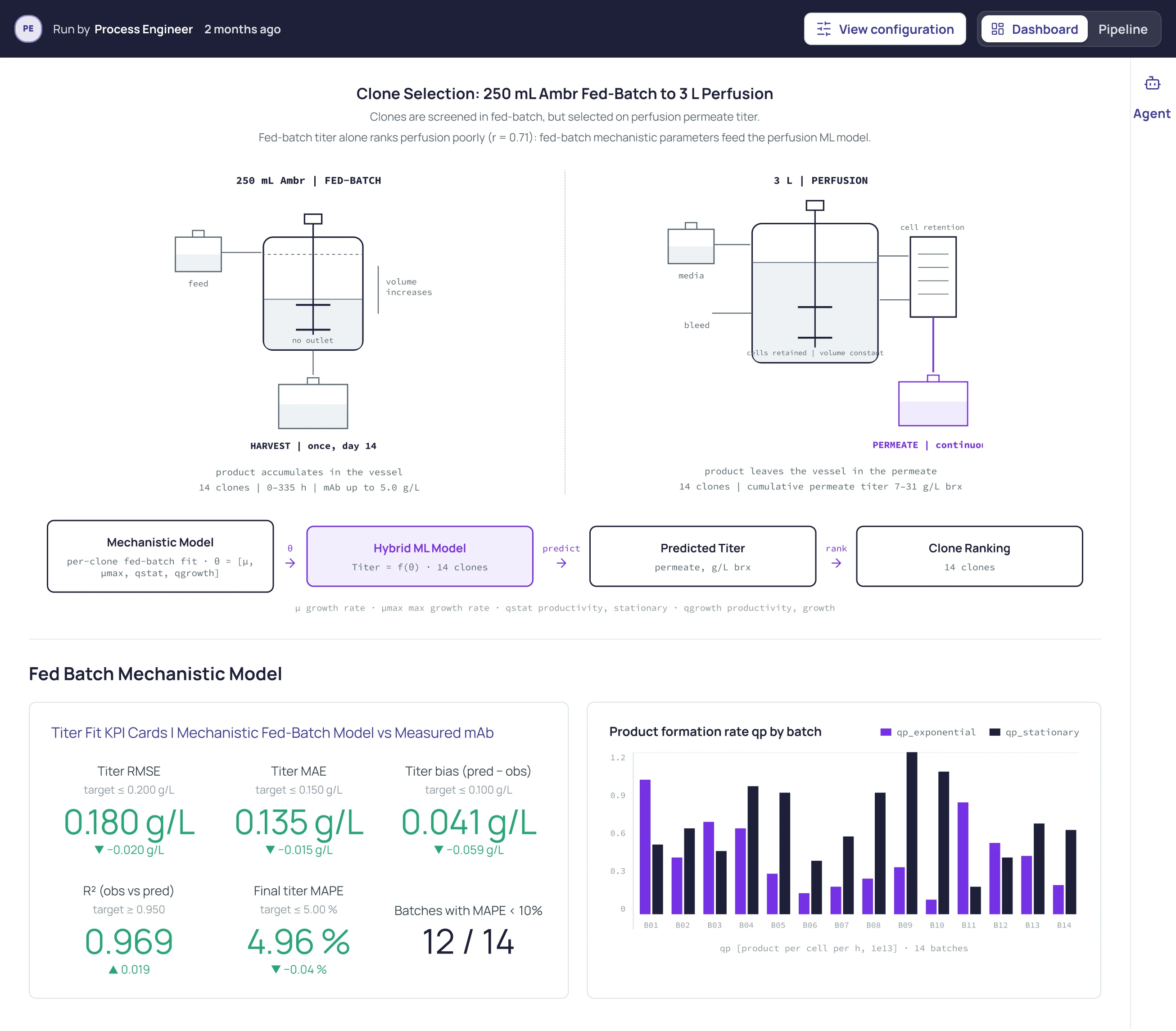
The full case study covers the data schema, fitted parameters, validation results, and the sweep behind the 20% titer increase.
This program used 12 Ambr15 fed-batch runs. Hybrid models need far less data than purely data-driven ones because the physics is already built in.
No. It tells you which clones are worth a confirmation run, so fewer 3 L runs are spent on clones that won’t hold up in perfusion.
In this program, process historian, ELN, and LIMS records were aligned into one dataset. The same approach applies to the systems your team already uses.
Against batches the model has not seen. Here it was fit on 12 fed-batch runs and tested on 3 held-out batches, reaching an R² of 0.94 and 4.1% MAPE on final titer.
Every prediction is traceable to the dataset and parameters behind it, so results can be reviewed and documented within a QbD framework. Talk to us about your validation requirements.
