
Why Quality Control Remains a Persistent Challenge in Specialty Chemical Manufacturing
In specialty chemical manufacturing, monomer quality directly impacts customer performance, product differentiation, and margin. Even small variations in monomer purity or consistency can lead to downstream processing issues, off-spec material, and lost commercial value. Despite significant investments in process control and automation, many manufacturers continue to struggle with maintaining consistent monomer quality at scale.1
This challenge is especially pronounced in complex production units such as reactive distillation, where reaction and separation occur simultaneously. These systems are highly sensitive to fluctuations in raw material quality, operating conditions, and energy inputs. Minor deviations in temperature, pressure, or feed composition can quickly cascade into reduced yield, higher rework rates, and off-spec product.2,3 As a result, quality issues are often detected only after value has already been lost—through wasted energy, constrained throughput, or missed customer specifications.
Why Traditional Quality Control Approaches Fall Short
Specialty chemical manufacturers often rely on offline laboratory testing, periodic sampling, and historical process knowledge to evaluate product quality.4 While these methods are widely used, they have limitations:
1. Delayed Quality Visibility: Quality attributes like purity or viscosity may only be known hours after a sample is taken.
2. Prolonged Cycle Times: Due to a lack of real-time process visibility, operators often run conservatively long cycles to ensure specifications are met, reducing throughput and increasing energy use.5
3. High Cost of Failure: Batch failures, rework, and raw material waste significantly increase production costs. Without real-time insights, manufacturers often discover issues only after a batch is complete and the product is deemed off-spec.
Together, these constraints leave teams operating reactively rather than proactively, limiting their ability to maintain quality, shorten batch durations, or optimize raw material usage.
Soft Sensing for Quality Monitoring in Monomer Production
To overcome these limitations, manufacturers are increasingly adopting soft sensing: AI-driven virtual sensors that infer quality attributes from real-time process data.
When a key process variable is too costly or impractical to measure with hard sensors, soft sensors enable the accurate prediction of these unobservable variables.
Soft sensors use process measurements (e.g., temperature profiles, flows, pressures, column tray metrics) and combine them with process understanding to estimate CQAs continuously throughout the batch.6
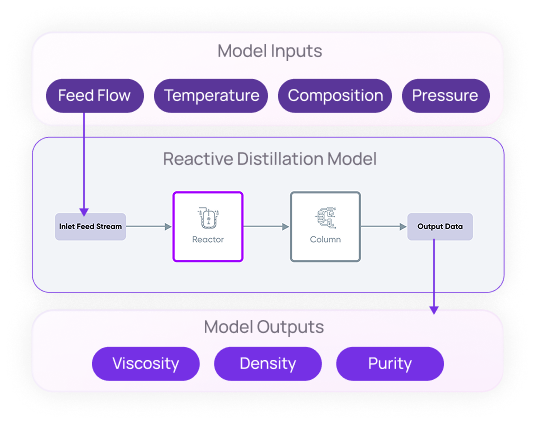
This shift from intermittent lab testing to continuous monitoring enables teams to reduce their reliance on delayed lab results and opens the door for early deviation detection, cycle endpoint prediction, increased time-to-market, and ultimately the reduction of energy and raw material consumption.
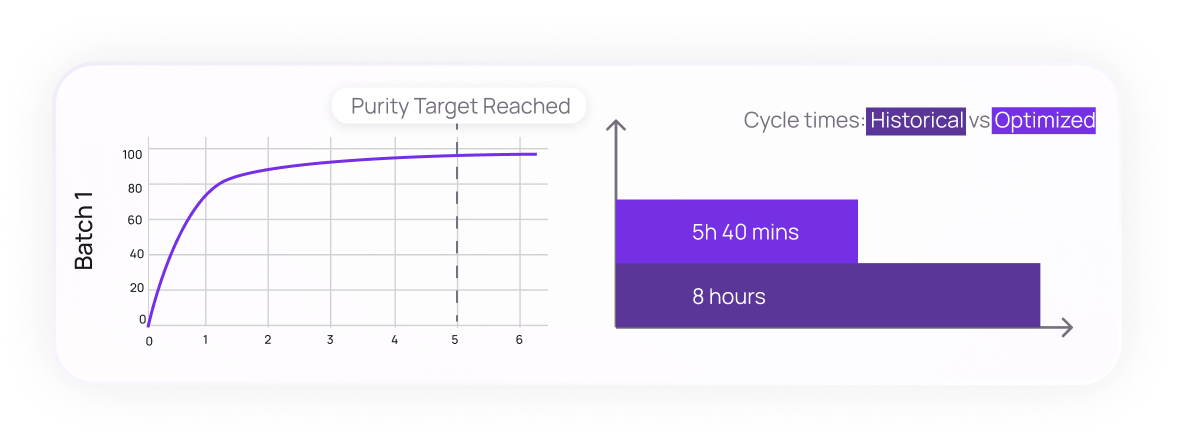
In a recent case study, a global specialty chemical company used soft sensing to gain visibility into a key quality attribute, purity, which was previously being measured post-batch.
From this, they enabled precise endpoint determination by understanding when their purity target had been reached and avoided overrunning their batch. The result was a reduction in their cycle times by 29%.
Predictive Modeling for Deviation Detection in Monomer Quality
AI-enabled technologies not only create visibility into quality attributes, they also enable manufacturers to detect process deviations as they emerge.
Small fluctuations in raw materials, temperature profiles, or feed composition can have a significant impact on quality attributes like purity or viscosity.3 Without real-time monitoring, these deviations are only identified after batch completion, when it is too late for intervention.
AI-driven deviation detection compares live process behavior against expected operating patterns learned from historical and model-derived data.7
For example, one of Basetwo’s customers deployed this approach in their monomer production process, reduced batch failures by 80%. They leveraged a predictive process model to visualize their batch metrics in real-time.
Using the Basetwo platform, they could see when temperature starts drifting outside its normal trajectory, purity progression diverges from established profiles (Figure 3). This visibility allows operators to intervene proactively rather than waiting for off-spec lab results at the end of the batch.
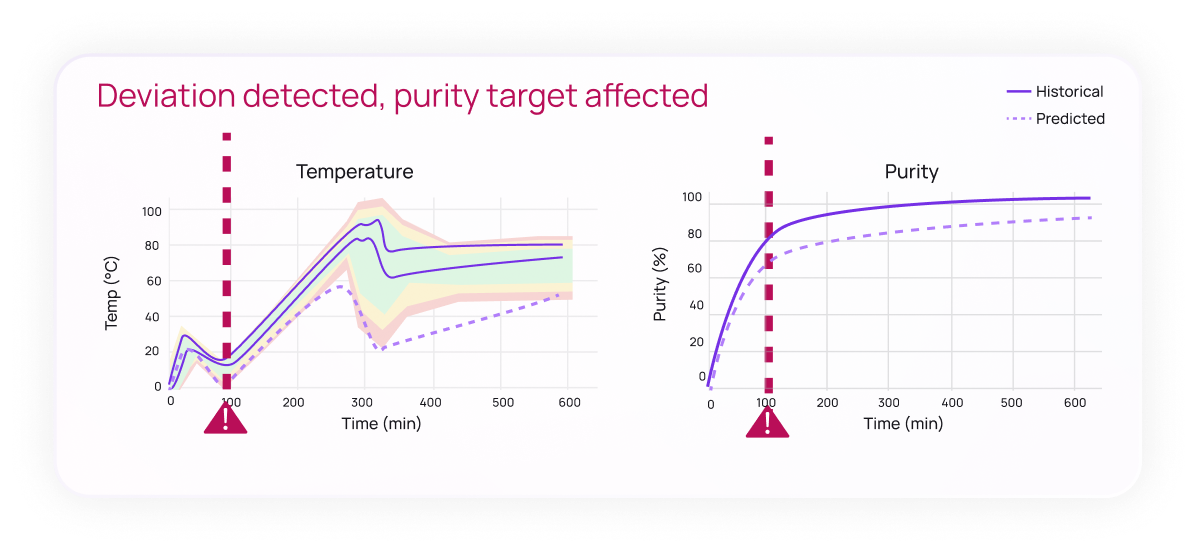
By identifying deviations early, manufacturers can stabilize the process, avoid unnecessary batch rework, and maintain product consistency even in the face of raw material variations or plant disturbances.
Conclusion
As manufacturers push for greater efficiency and consistency, AI-driven technology like soft sensing and predictive modeling offers a practical and scalable path to predictive quality control—delivering the real-time visibility needed to improve reliability across monomer production.
To explore advanced process control for your processes, schedule a time with a Basetwo expert.
References
- Cheng, D., & Pan, T. (2023). Effects of monomer purity on AA-BB polycondensation. Polymer Bulletin. https://doi.org/10.1007/s00289-023-05015-w
- Kiss, A. A. (2011). Reactive distillation: A review. Chemical Engineering and Processing: Process Intensification, 50(6), 517–514. https://doi.org/10.1016/j.cep.2011.02.006
- Sundmacher, K., & Kienle, A. (2003). Modeling and optimization of reactive distillation systems. Computers & Chemical Engineering, 27(11), 1509–1521. https://doi.org/10.1016/S0098-1354(03)00115-3
- AmrepInspect. (n.d.). Quality control methods in chemical manufacturing. https://amrepinspect.com/blog/quality-control-methods
- Dunnebier, M. P., Laird, C. D., Taylor, R., & Krishna, R. (2021). Troubleshooting an industrial batch process for the manufacturing of specialty chemicals. In Chemical Engineering Process (pp. 189–214). Elsevier. https://doi.org/10.1016/B978-0-12-823377-1.50189-0
- ScienceDirect. (n.d.). Soft sensor — Engineering topic. ScienceDirect Topics. https://www.sciencedirect.com/topics/engineering/soft-sensor
- Qin, S. J. (2012). Survey on data-driven industrial process monitoring and diagnosis. Annual Reviews in Control, 36(2), 220–234. https://doi.org/10.1016/j.arcontrol.2012.09.004


