
An AI controller autonomously delivered predictive control of a bioreactor, automatically adjusting nutrient feeds to keep glucose, cell viability, and titer within the target range, using existing process instrumentation and robotic sampling.
TORONTO and UK, Nov 11 — Basetwo AI, which builds agentic digital twin software for pharmaceutical and chemical manufacturing, successfully demonstrated predictive control of a bioreactor in a flagship initiative in collaboration with CPI, Labman, and Nicoya. The three companies demonstrated fully autonomous closed-loop control in fed-batch bioreactors producing Trastuzumab, a biosimilar candidate for HER2 breast cancer treatment.
The autonomous AI system successfully predicted glucose demand from cellular activity and automatically decided the feed timing and amount without human intervention. Using this approach, glucose levels were maintained at the target band without a spectroscopic probe. The autonomous control was successfully able to improve cellular viability and titer (yield) in comparison to manual control - which produced glucose-limited conditions in the reactor.
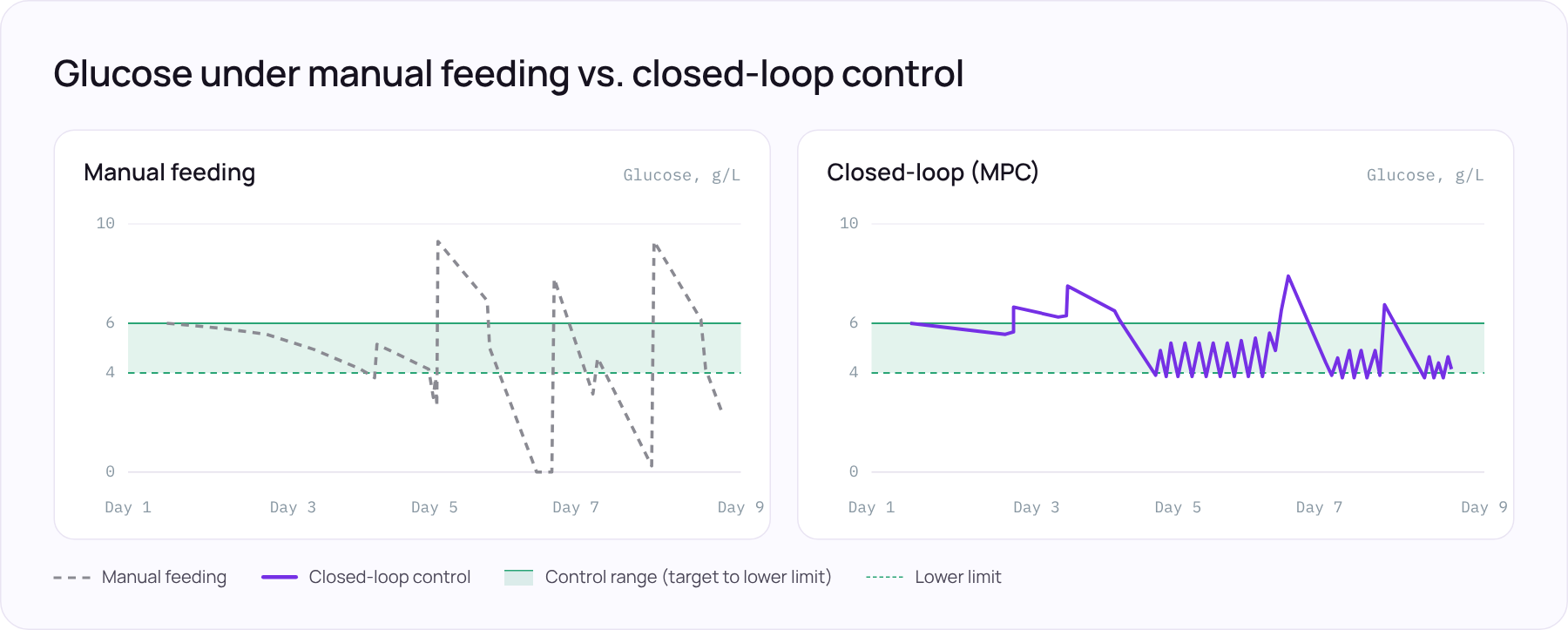
The result addresses a common challenge in biopharmaceutical manufacturing and development: achieving continuous visibility and control of critical process variables (CPVs) without relying on additional analytical instrumentation or manual intervention.
Today, many bioprocessing teams rely on periodic lab measurements to monitor CPVs like glucose, viable cell density and titer leaving operators without visibility between samples. While spectroscopic process analytical technologies (PAT) such as Raman and NIR can provide more frequent measurements, their adoption can be costly, requiring additional hardware, calibration, and ongoing maintenance.
This collaboration demonstrates an alternative to manual sampling and costly instrumentation. By combining label-free quantitation of antibody titer and automated robotic sampling with autonomous AI closed-loop control, this approach offers a potential pathway for bioprocess teams to implement advanced control strategies using the infrastructure they already have.

"Biopharma manufacturers have invested heavily in bioreactor infrastructure, but critical process decisions still depend on measurements taken hours apart," said Thouheed Abdul Gaffoor, CEO of Basetwo. "This work with CPI, Labman, and Nicoya demonstrates that we can use the data already coming from a bioreactor to predict what's happening inside it, automatically adjust the process and ultimately produce higher performance outcomes. This approach makes autonomous process control more accessible without requiring manufacturers to install additional spectroscopic instrumentation."
“The real opportunity here isn't simply automating laboratory activities, but using the data we generate to make better decisions as a bioprocess develops," said Philip Probert - Director of Biologics, RNA Centre of Excellence and Medicines Manufacturing Innovation Centre at CPI. "By bringing together automated sampling, analytics and AI-driven control, this collaboration has demonstrated how processes can respond to information in real time, reducing reliance on manual intervention. Demonstrating this approach across different bioreactor scales is an important step towards more autonomous bioprocess development. It highlights the potential to accelerate process understanding, make better use of experimental data and ultimately develop more efficient and robust manufacturing processes. This is a great example of how collaboration between technology developers and bioprocessing experts can help translate emerging technologies into practical solutions for industry."
"This is a really exciting development for Labman," Tom Smith, Head of Bioprocess Automation at Labman said. "As an engineering company, we’ve been able to develop a new platform that automates the sample journey from the bioreactor, a process that has traditionally involved a lot of manual work, from sub-sampling and sample preparation through to equipment integration. We’re agnostic to the workflow and its requirements, so it’s great to be opening up new opportunities to automate this upstream process."
“Real-time process control depends on knowing what’s actually in the vessel, not just what the sensors around it are reporting,” said Jamie McQuay, VP of Engineering at Nicoya. “Getting that answer has traditionally meant pulling a sample and waiting on the lab. In this platform, Digital SPR is built into the workflow. The sampling robot draws from the bioreactor, the instrument quantifies antibody titer straight from the crude sample, and the number is there while the run is still going. No labels, no manual steps, and no waiting.”
The results show that closed-loop glucose control doesn't have to wait for slow, manual lab samples or spectroscopic probe, teams can start on the vessels and data they have available. This approach enables process development teams to rapidly screen multiple process setpoints, media types, and clones while holding glucose and process conditions stable without human intervention.
To explore the project in detail, register for the panel discussion here.
About Basetwo
Basetwo AI, based in Toronto, provides an agentic AI platform for manufacturers in pharmaceuticals and advanced materials. It enables process teams to rapidly build digital twins to accelerate development, scale-up and tech transfer timelines, as well as monitor and control quality in real-time at the commercial scale.
Media contact
Victoria Galimanis, victoria@basetwo.ai
From months of trial batches
to answers in an afternoon.
